
Multidisciplinary Research Center
The Multidisciplinary Research Center at GNIOT is a dynamic initiative designed to foster innovation, interdisciplinary collaboration, and high-impact research. It brings together students, faculty, and researchers from various departments to work on emerging technologies and real-world challenges.
GNIOT proudly hosts two advanced and industry-supported research labs:
1. Intel® Unnati Lab @ GNIOT
The Intel® Unnati Data-Centric Labs at GNIOT is a state-of-the-art facility designed to foster innovation and research in the field of emerging technologies. In an era where data-driven research and computational power define progress, the Intel® Unnati Lab emerges as a transformative facility designed to bridge academia, industry, and cutting-edge technology. Built on the robust foundation of Intel’s state-of-the-art architecture, this lab is equipped with a powerful Master and Compute Node infrastructure. It boasts an impressive 30 Intel® Xeon® processors, enabling unparalleled performance and scalability.
What is the Intel® Unnati Lab?
The Intel® Unnati Program is a visionary initiative by Intel aimed at accelerating digital readiness and technical excellence in higher education. The Unnati Lab is a physical manifestation of this goal, offering faculty, students, and researchers direct access to high-performance computing resources and modern development environments.
Architecture Overview: Master and Compute Nodes
- 1 Master Node: The command center of the cluster, coordinating tasks, managing job scheduling, and handling user access.
- Multiple Compute Nodes: Specialized systems dedicated solely to executing compute-heavy operations in parallel.
Together, these nodes work seamlessly to deliver distributed computing capabilities, optimized for workloads in artificial intelligence, machine learning, big data analytics, and scientific research.
30 Intel® Xeon® Processor Workstation
The lab is powered by 30 Intel® Xeon® processors, known for their:
- High core counts and multi-threading: Ideal for parallel computing and handling complex workloads.
- Advanced memory support: Ensuring efficient data access for large-scale simulations and models.
- Scalability and reliability: Enabling consistent performance in demanding environments.
Whether it’s training deep neural networks or simulating engineering models, the Xeon-based compute nodes provide the muscle needed to deliver results—fast and accurately.
Objectives of the Intel® Unnati Lab at GNIOT
The lab has been developed with the following goals:
- Promote Multidisciplinary Research: Facilitate cross-departmental collaboration among students and faculty from Computer Science, Electronics, Electrical, Mechanical, Civil, and Management disciplines.
- Enable Industry-Ready Skill Development: Provide hands-on training to students in emerging technologies like AI, ML, and IoT, using Intel-powered hardware and software stacks.
- Support UG/PG Projects and Startups: Serve as a project incubation space for undergraduate and postgraduate students, promoting innovation and entrepreneurship.
- Encourage Collaborative Innovation: Promote participation in Smart India Hackathons, innovation challenges, and collaboration with industries, startups, and research organizations.
2. STMicroelectronics AIoT Lab @ GNIOT
About the Center
In an era driven by smart systems, connected devices, and real-time intelligence, engineering education must go beyond textbooks to offer practical, industry-aligned exposure. In alignment with this need, Greater Noida Institute of Technology (Engineering Institute) has partnered with STMicroelectronics—a global leader in semiconductor solutions—to establish a cutting-edge AIoT (Artificial Intelligence of Things) Lab on campus.
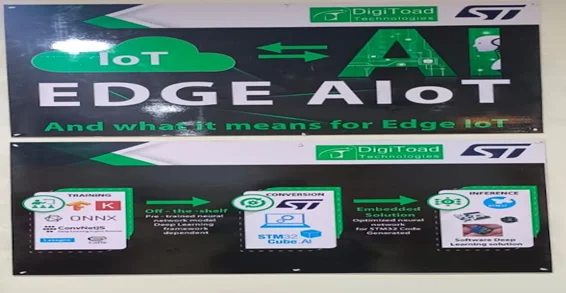
The STMicroelectronics AIoT Lab has been established to be a center for innovation, applied research, and skill development in the domains of embedded systems, IoT, machine learning, and smart electronics. This lab serves as a multidisciplinary platform that integrates the strengths of Electronics, Computer Science, Electrical, and Mechanical Engineering, making GNIOT a pioneer in AIoT education and innovation in the Delhi–NCR region.
Objectives of the AIoT Lab
The primary goals of the ST AIoT Lab at GNIOT are:
- To create a multidisciplinary research environment focused on the convergence of AI, embedded computing, and the Internet of Things
- To provide a hands-on learning platform for students to build smart applications using real-time data and sensor networks
- To support project-based learning, research publication, and prototype development in emerging technologies
- To encourage faculty-student-industry collaboration on industry use cases, hackathons, and open innovation challenges
- To equip students with skills aligned to the job roles of the future, such as embedded AI engineers, IoT developers, and edge computing specialists

Multidisciplinary Applications and Research
The AIoT Lab encourages students and researchers to solve real-world problems using cross-domain collaboration. Projects span various departments:
- Electronics & Communication Engineering
- Sensor interfacing, signal conditioning, and real-time embedded AI processing
- Smart traffic control systems, motion detection systems
- Computer Science & Engineering
- AI algorithm development for microcontrollers (e.g., gesture recognition, voice commands)
- Smart data collection, local analytics, and cloud sync
- Electrical Engineering
- Smart energy meters, AI-enabled fault detection in distribution lines
- Real-time monitoring of power parameters using embedded systems
- Mechanical Engineering
- Condition monitoring systems using vibration sensors
- Predictive maintenance for rotating machinery via embedded AI
Both the labs have been instrumental in transforming how students approach their academic projects and professional development:
- Project Support: Final year and mini projects now include AI-based temperature sensing, motion detection, gas leakage detection, and health monitoring systems
- Workshops and Certifications: Students undergo structured training in embedded programming, IoT frameworks, and AI model deployment on MCUs
- Placement Readiness: Graduates with lab exposure are better equipped for roles such as Embedded Software Engineer, IoT Application Developer, and AI Developer
- Startup Culture: The lab serves as a springboard for prototype development under GNIOT-IIC and national-level contests like Smart India Hackathon